
Projected vs Actual Release Date
A Haralson County projected release date depends on custody type. A pretrial detainee usually has no fixed GDC date because bond, court orders, holds, disposition, or transfer control the exit. A county sentence is calculated from the court order and jail record. State prisoners may have a Tentative Parole Month or Maximum Release Date.
Find Haralson Projected Release Dates
Use the system holding the person. The county roster cannot calculate state discharge, and GDC does not replace local records for a pretrial booking.
- Check the Haralson roster for current county custody.
- For a local sentence, ask the sheriff for the release record and compare the Clerk's sentencing order.
- For state custody, search the GDC offender query by ID or name, then use inactive or all scope when needed.
- Check the TPM lookup for parole review timing.
- Request written GDC verification if a result is unclear.
A transfer from Haralson County Jail to GDC is not community release.
Good-Time Credit and How Release Dates Are Computed
Georgia has no blanket 85 percent rule. O.C.G.A. 42-5-101 authorizes work incentive credits. GDC's PIC program lets eligible people earn up to 12 points and potentially reduce TPM or MRD by one to 12 months through programs, work, and good conduct. Certain short, life, death, mandatory-minimum, and parole-ineligible sentences are excluded.
General felony parole consideration begins after nine months or one-third of the sentence, whichever is greater, subject to exceptions. Eligibility permits review; it does not require release. Serious violent felony rules can bar parole or impose much stricter timing.
Why a Projected Release Date Changes
Dates change for several documented reasons.
| Factor | Effect | Source |
|---|---|---|
| Misconduct | TPM delay or credit loss | GDC or Board |
| PIC progress | Possible reduction | GDC |
| Detainer or charge | Continued or transferred custody | Agency and court |
| Board reconsideration | Changed parole timing | Parole Board |
| Sentence recalculation | Revised MRD | GDC or sheriff |
Residence checks, court orders, bond processing, hold clearance, weekend staffing, medical transport, and another agency's pickup can also affect the actual exit.
Confirming a Release Date
Use VINELink for custody-change alerts, not as the sole proof of legal status. Confirm county dates with the jail and court, state dates with GDC, and parole decisions with the Board. After parole, DCS supervision is separate from prison custody. A person can be physically released while the sentence remains active.
O.C.G.A. 17-10-6.1 governs serious violent felony restrictions. Offense and crime date matter, so do not replace the statute and official record with a percentage shortcut.
Haralson TPM and MRD Fields
Georgia records use two important labels instead of one universal projected date. A Tentative Parole Month, or TPM, belongs to the Parole Board process. It marks the month when the Board plans to complete final review and decide whether to set a parole release date. A Maximum Release Date, or MRD, belongs to the sentence and custody calculation. GDC's incentive program can affect either field for an eligible person.
Neither label should be converted into a guaranteed Haralson County exit date. The Board can postpone or cancel a TPM after misconduct or unmet program conditions. It can also reconsider an earlier decision before the release takes effect. An MRD may change after sentence recalculation, new legal credit, a court order, or another lawful adjustment.
The public TPM lookup accepts a six-digit inmate number, GDC ID, or personal data. Search results should be matched carefully. A TPM result does not mean that parole has begun. Once release actually occurs, the parolee database and DCS supervision record answer the separate question of whether community supervision is active.
Haralson Jail Release Calculations
A person held before trial has no sentence-based projected release date. Bond may be set, but the presence of a bond amount on the roster is not proof that it was posted. Release can wait on payment processing, property or professional bond approval, warrant clearance, court paperwork, medical needs, or another agency's decision about a hold.
For a county-sentenced person, the sentencing order establishes the term. The Haralson County Jail and court records are the proper sources for credit and completion. The online arrest-date roster may later say RELEASED, but the visible text did not show a precise release timestamp during research. Ask the sheriff for the booking record, exact date and time, release authority, and any transfer notation.
Reception is the sheriff division's stated point of contact for warrants, bonding, and inmate release. The Clerk of Superior Court keeps sentences and sentencing packages. Reading those records together distinguishes a community release from a transfer into GDC custody. A county roster can mark its own booking released even though another agency still holds the person.
Georgia Parole Eligibility Timing
O.C.G.A. 42-9-45 provides the broad eligibility floor. For most felony sentences, consideration begins after nine months or one-third of the sentence, whichever is greater. That date is only the point at which the Board may consider parole. The Board's own process material says few eligible people are released at the first possible date.
Parole decision guidelines combine crime severity and a risk score to create a recommendation. The Board may accept or reject it and keeps discretion. It may set a future TPM, deny parole, reconsider later, or impose conditions that must be completed before release. Residence-plan verification can also affect final timing.
Serious violent felony and recidivist rules can override the general floor. Some non-life serious violent felony sentences for crimes committed on or after January 1, 1995 are parole-ineligible. Life-sentence eligibility periods vary by offense date and governing law. This is why a generic percentage cannot accurately answer when every Georgia prisoner will leave.
Georgia Credits Change Haralson Dates
The Performance Incentive Credit program rewards progress rather than the mere passage of time. Eligible people can earn points through education, vocational work, treatment, assigned work details, and good conduct. GDC says as many as twelve points may produce one to twelve months of reduction from a TPM or MRD.
Credits do not apply to every sentence. GDC excludes categories such as death sentences, sentences of two years or less, life sentences, non-parole-eligible offenses, and certain mandatory minimum terms. The controlling sentence and offense must be checked before estimating any reduction. A person cannot safely infer eligibility from another prisoner's result.
Conduct matters twice. Good behavior supports program participation and credit, while disruptive behavior can keep a person out of groups or work details and delay completion. GDC reports work incentive credits to the Parole Board, which may consider them when making a final parole decision. The calculation therefore includes statutory eligibility, GDC administration, and Board judgment.
The official GDC PIC explanation shows the current program framework.
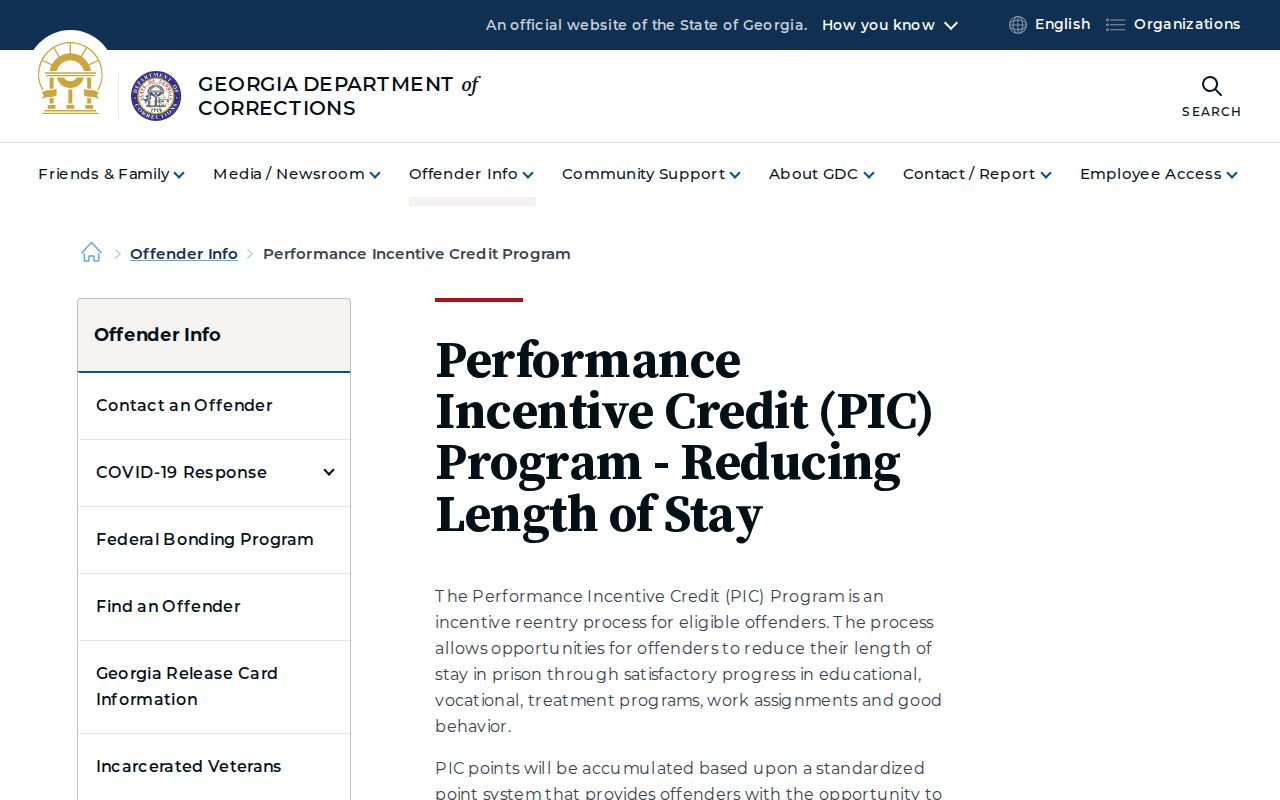
The captured program page supports the distinction between potential credit and a final release order.
Confirm Haralson Actual Release
A projected date becomes historical fact only after the custody record changes. For Haralson County Jail, compare the current roster, arrest-date status, sheriff release entry, and court file. For GDC custody, read the offender record and obtain written verification when the public result is ambiguous. For parole, check the Board record and DCS supervision layer.
VINE can provide a useful alert when a participating agency reports release or transfer. Treat the message as a prompt to confirm the event. A transfer notification can mean continued custody at a different facility, while a release notification may not explain bond terms, probation, parole, or a separate detainer.
New charges and holds can alter the destination even at the end of a sentence. Another county, GDC, federal authorities, or immigration authorities may take custody. Only the agencies involved can confirm that chain. The exact date and the legal meaning of release should come from the record created by the office responsible for it.
Read Haralson Release-Date Records
The GDC query supports last and first name, GDC ID, case number, gender, race, age and description, most recent institution, offense, county, and active, inactive, or all scope. A released state prisoner may be missed by an active-only search. Search with an ID when possible, then narrow a name result by county, offense, or institution.
Open the detailed record and distinguish the custody field from the sentence and supervision fields. A former institution is not proof of present custody. A photograph, when available, displays automatically, but it is only an identity aid. GDC warns that users should seek written verification from Inmate Records and Information before treating the public entry as complete.
The Parole Board's TPM tool and parolee database serve different phases. TPM is for a person awaiting a parole decision in prison. The parolee database can show a parole begin date, end date, office, office phone, and primary offense after release. DCS Cedartown supervises Haralson County parole and felony probation in the local circuit.
For county custody, read the arrest date, status, days in jail, bond, warrant, charge, and court fields together. Status: RELEASED confirms the booking is no longer active, but the sheriff record is still needed for the exact time, authority, and destination.
Request Haralson Release-Date Verification
GDC directs written questions to Inmate Records and Information at P.O. Box 1529, Forsyth, GA 31029. Include enough identity detail to distinguish the person and state the date or sentence field that needs confirmation. For a county booking, use the Haralson sheriff open-records channel and identify the booking, case, and requested release fields.
A precise request is easier to answer than a broad demand. Ask for the release date and time, release type or authority, receiving agency if transferred, and the record supporting the calculation. Compare the response with the court sentence before treating it as final.
Keep the response with the sentencing order and any later Board or court notice. Dates viewed on different days can disagree because each system records a different stage. The jail records physical custody, the court records legal authority, GDC calculates state confinement, the Board controls parole decisions, and DCS records community supervision. A sound Haralson County projected release date check identifies which office created each field before resolving the difference.
The final Haralson release record should always control over an earlier estimate or tentative month.
Public Record Search
Sponsored Results