
Haralson Court Release Paths
The Clerk of Superior and Juvenile Courts files and processes warrants, indictments, accusations, and sentences in felony and misdemeanor cases. It also processes sentencing packages for transfer into the state system. Those records outlast a short-lived roster entry and often explain whether a person left jail on bond, completed a sentence, received probation, had a charge dismissed, or moved into Georgia Department of Corrections custody.
Magistrate Court has an earlier role. Its criminal work includes first appearances, preliminary hearings, arrest warrants, and search warrants. A bond decision may arise early, while a later Superior Court disposition gives the durable case outcome. Neither court record alone proves the exact time jail staff completed physical release processing.
| Outcome | Follow-up record |
|---|---|
| Bond release | Bond order, sheriff release entry, case docket |
| Time served or probation | Judgment and sentencing order |
| Dismissal | Filed disposition and jail release entry |
| State prison transfer | Sentencing package and GDC offender record |
Confirm Haralson Court Releases
Start with the person’s name, case number, arrest date, and court shown on the jail roster. The roster’s charge rows can identify a warrant, statute, charge description, and court. Those details help distinguish cases and direct a request to the correct clerk.
- Check the sheriff’s arrest-date roster for the booking and its released or currently booked status.
- Use Georgia Courts eAccess as an online gateway where a Haralson provider is available.
- Contact the local clerk for the docket, disposition, judgment, sentence, probation order, or certified copy.
- Compare the court date and order with the sheriff’s release or transfer record.
- If the sentence led to state custody, continue through the GDC offender query and parole sources.
Important: A court order explains legal authority. The sheriff’s record confirms when the jail completed the custody change.
The Haralson County released-inmate search covers the full fallback chain when the court file is only one part of the answer.
Haralson Court Records Contact
The Clerk of Superior Court is the long-term source for the criminal case records described by the county. A precise request should identify the person, case number, court division, charge, and date range, then name the document sought. Ask about copy certification, current fees, and delivery before submitting a broad request.
P.O. Box 849
4485 GA Hwy. 120
Buchanan, GA 30113
770-646-2005
Fax: 770-646-8827
Monday-Friday, 8:30 a.m.-5:00 p.m.
Magistrate Court is at the same highway address with P.O. Box 1040, phone 770-646-2015, and fax 770-646-2013. Contact that court for its early-stage criminal records when the release issue stems from first appearance, a preliminary hearing, or a warrant matter.
The Georgia Courts gateway illustrates the statewide route to available court-record providers:
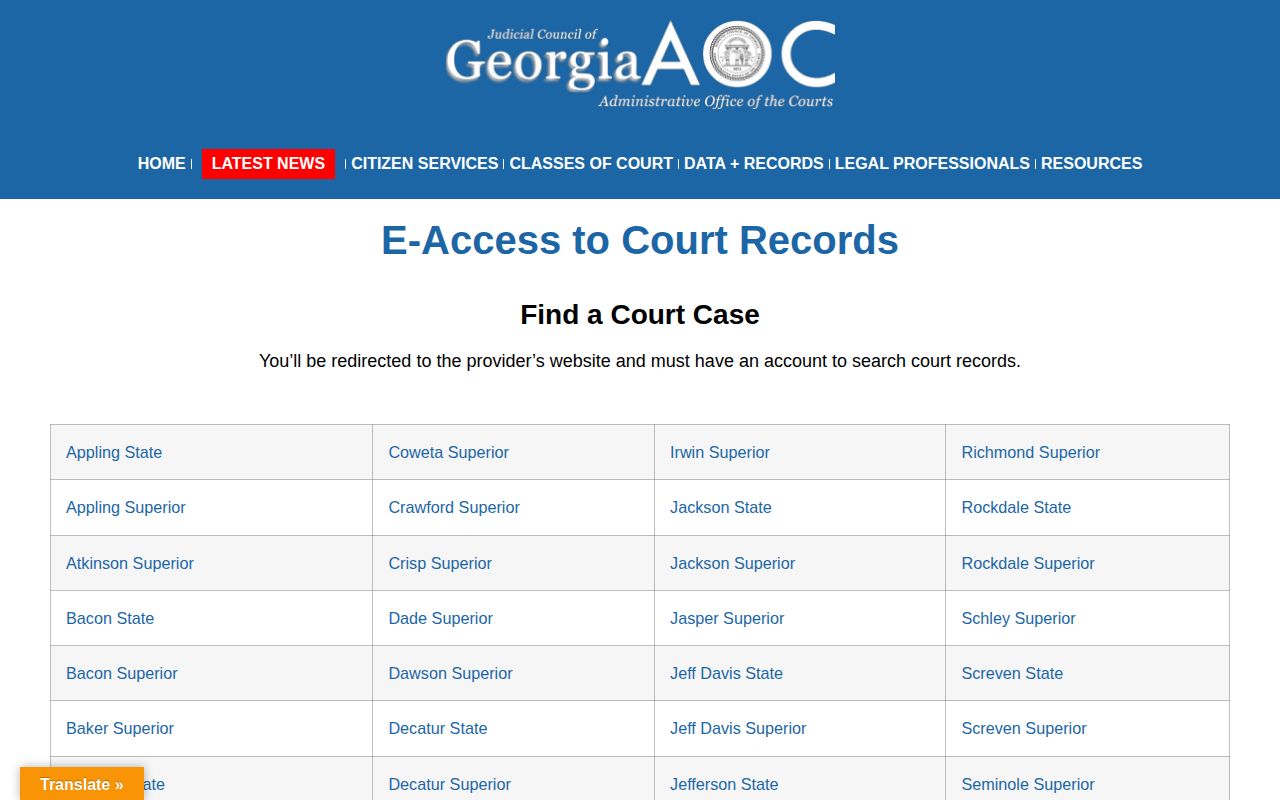
Online availability varies, so the local clerk remains the source for certified Haralson County copies.
Haralson Release Record Fields
A useful court request targets existing documents rather than asking staff to create a narrative. Depending on the case, the file may contain a warrant, accusation, indictment, bond order, docket entry, plea, judgment, sentence, probation order, dismissal, or state-transfer package. The exact set depends on how far the case proceeded and which court had jurisdiction.
- Disposition
- The recorded outcome of a charge or case, such as dismissal, plea, or judgment.
- Sentence
- The court’s ordered legal consequence after conviction or plea.
- Remand
- An order returning a person to custody or sending a matter back for further action.
- Certified copy
- A copy authenticated by the records custodian for formal use.
The court file may show that confinement was credited as time served or that probation began. It may also show a sentence to GDC, which means the county booking ended through transfer rather than community release. Read the operative order, not just a docket caption.
Haralson Bond Release Records
Haralson County publishes detailed professional, property, cash, and transfer-bond rules. A bond allows release from jail while the case remains open. It is not a disposition. The sheriff’s bonding guidelines also describe a later cash-bond refund process requiring certified proof of disposition signed by the judge or clerk.
This creates two distinct record moments. The sheriff’s bond and release paperwork documents the custody event. The courthouse record shows what eventually happened to the case and supplies the proof needed for a refund request. A person may therefore appear released long before any final judgment.
Property and cash bonds carry a published $20 sheriff bonding fee. Professional companies set their own charge within the range stated by the sheriff page. Use the official bond record for the bond type and amount, then the filed disposition for case completion.
Haralson Sentence Transfer Records
The clerk processes sentencing packages for transfer of prisoners into the state system. When that occurs, a person can disappear from the county’s Current Inmates view and later appear in GDC. The county booking has ended, but custody continues under the state sentence.
Confirm the chain with three records: the court’s judgment and sentencing package, the sheriff’s transfer or release notation, and the GDC offender record. The GDC query can be searched across active, inactive, or all scopes. Written GDC verification is appropriate when the public result lacks enough detail.
After state release, parole may be shown through the Parolee Search and supervised by DCS Cedartown. A misdemeanor probation order instead points to Haralson County Probation. The court sentence is the map that selects the right post-release office.
Haralson Restricted Court Records
Georgia public-record law allows access subject to exemptions and court rules. Juvenile, sealed, restricted, medical, protected-identifier, victim, and some investigative material may not be available in full. A custodian may redact protected fields or deny a record under a cited rule. Availability should not be inferred from a search engine result.
First-offender discharge under O.C.G.A. 42-8-60 can have significant legal effects, but it does not justify saying every historical jail or court record vanishes automatically. Record restriction, sealing, first-offender status, and expungement are distinct concepts under Georgia practice.
Ask the clerk what can be supplied from the official file. For the jail’s own booking and release record, use the sheriff’s open-records process. Each custodian applies the rules to the records it maintains.
Older Haralson Release Cases
Older bookings may no longer appear in the public arrest-date search because the sheriff does not publish a fixed roster retention period. Court records can preserve the disposition and sentence after that display changes. Search by case number when possible, since a name-only inquiry can miss spelling differences or mix separate cases.
For the custody timestamp, send a focused open-records request to the sheriff. For the legal outcome, request the clerk’s existing docket and operative order. For a state sentence, add GDC written verification. These sources may have different retention rules and lawful redactions, so an absent online result should lead to the records custodian rather than a conclusion that no release occurred.
A certified disposition can also be more useful than a screen capture when a formal court or legal process requires an authenticated record. Ask the clerk what certification is available and what current copy charge applies. Do not assume an online gateway provides every Haralson criminal document or the final version of an amended order.